
Journal·October 6, 2026·geology · sedona · red-rocks · local-knowledge · things-to-do
Four Hundred Million Years in the Making: How Sedona's Red Rocks Got Here
The red rocks outside your window aren't just scenery — they're a readable record of ancient seas, deserts, and slow violence done by water
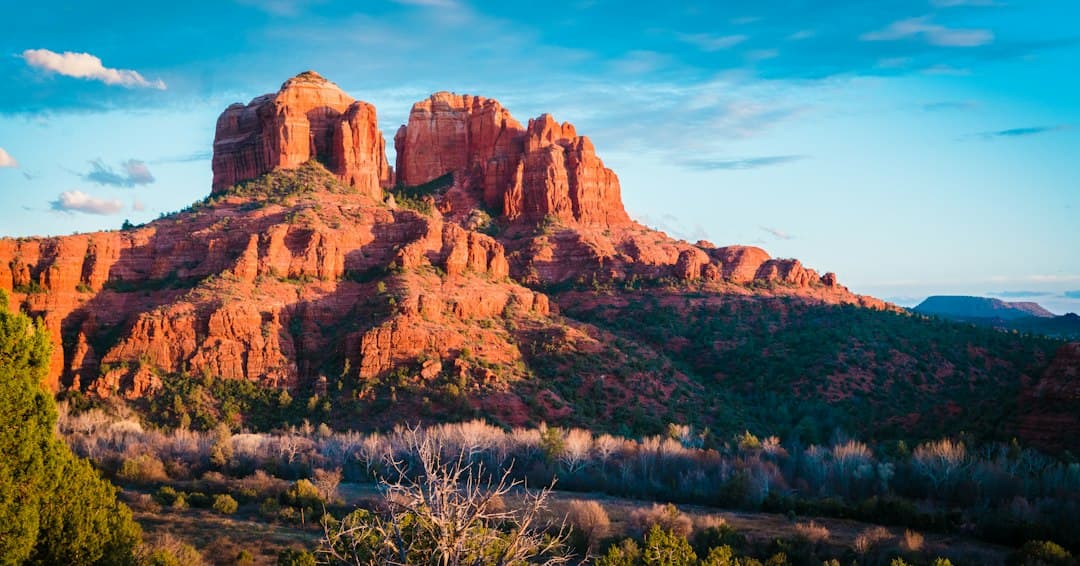
Photo by Kaileen Fitzpatrick on Unsplash
Spend a few days here and someone will eventually ask you: why are they so red? It's a fair question. The color alone stops people mid-sentence. But the more interesting story isn't the color — it's everything that had to happen, over an almost incomprehensible stretch of time, to stack these formations the way they are now.
I've lived near these rocks long enough that I sometimes forget to look at them. Writing this forced me to actually sit with what I know, talk to a few people who know more, and think about what I'd want a curious guest to understand.
It Starts With Ancient Seafloor
About 330 million years ago, this part of Arizona was covered by a shallow inland sea — something like the present-day Gulf of Mexico, warm and full of marine life. As organisms died, their shells and sediment accumulated on the seafloor in thick layers. Over millions of years, those layers compressed into limestone.
That limestone forms the base of much of what you see today, though it's mostly hidden underground or exposed in canyon bottoms. You're standing on an old ocean. That part never gets old to me.
Then the Desert Came
Around 270 million years ago, the sea retreated and the region became a massive desert — think Sahara-scale. Enormous sand dunes, some hundreds of feet tall, piled up and slowly hardened into sandstone. This is the Schnebly Hill Formation, and it's responsible for most of the rust-red color you see on the main formations.
The red comes from iron oxide — essentially rust — coating individual sand grains. When the iron in the ancient sand oxidized in that dry, oxidizing environment, it turned red. That's it. The whole dramatic palette of Sedona comes down to oxidized iron and time.
Above the Schnebly Hill layer sits the Coconino Sandstone — lighter in color, almost cream-colored in some light. You can see the transition clearly if you look at Cathedral Rock or the cliffs along 89A near Slide Rock. The color shift from red to tan marks a shift in ancient environments, from iron-rich desert sand to cleaner quartz-dominated dunes.
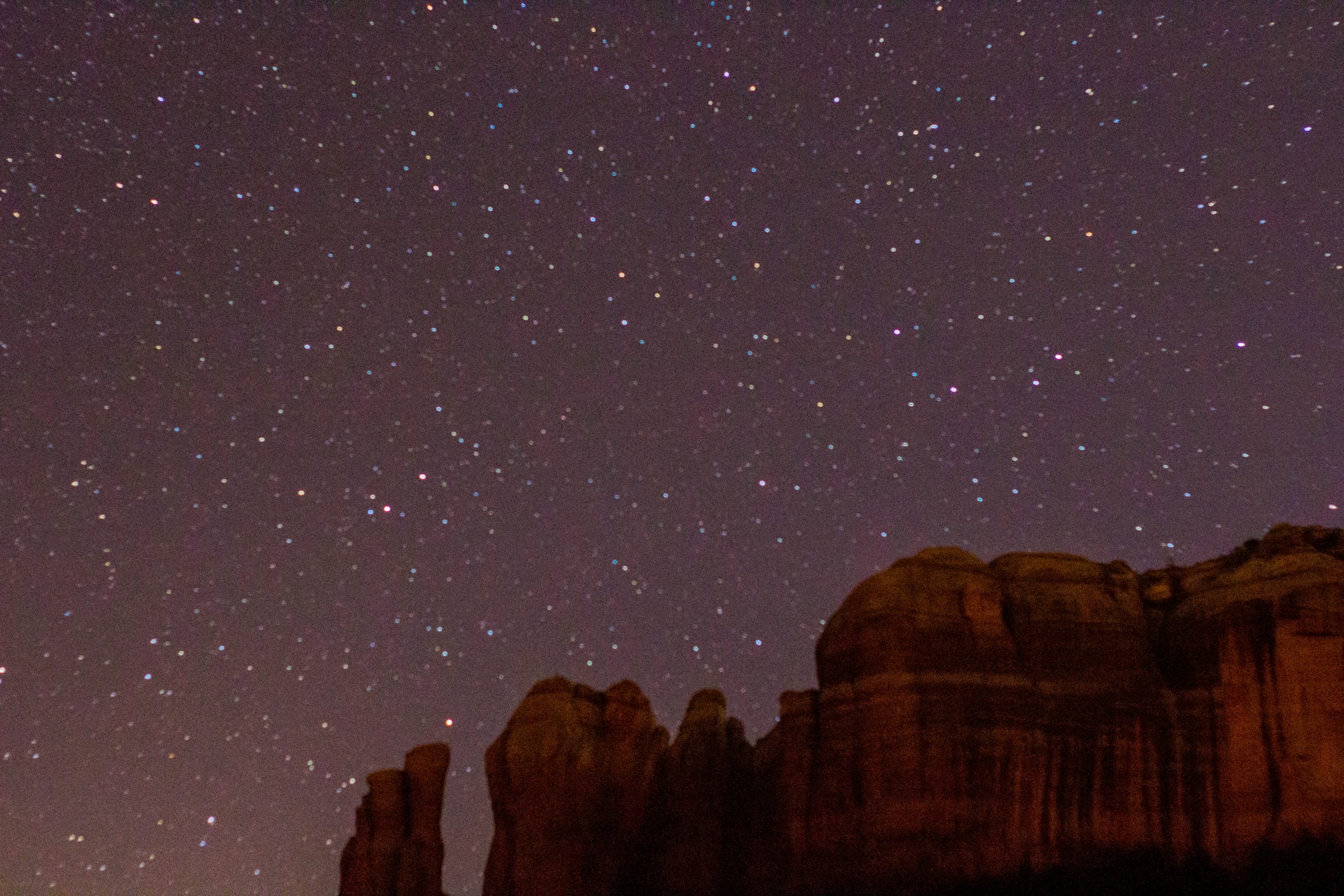
Cathedral Rock's layered profile makes it one of the clearest places to read the geological record — even at night, the stacked formations are distinct.
Water Did the Sculpting
So you have hundreds of millions of years of sediment, compressed and cemented into stone. The carving came later — and it's still happening.
Oak Creek has been cutting through the Colorado Plateau for millions of years. Freeze-thaw cycles crack rock faces from the outside. Monsoon rains run off the plateau in sheets and carve gullies. Wind does slower work. What's left standing — Bell Rock, Courthouse Butte, Cathedral Rock, Coffee Pot — are the harder, more resistant portions of the formation. The softer material around them washed or crumbled away.
Bell Rock is a good example. That smooth, layered dome shape isn't an accident. Each visible band represents a different period of deposition, harder or softer depending on mineral content, eroding at different rates. Walk around it slowly sometime. You can almost read it like a stacked archive.
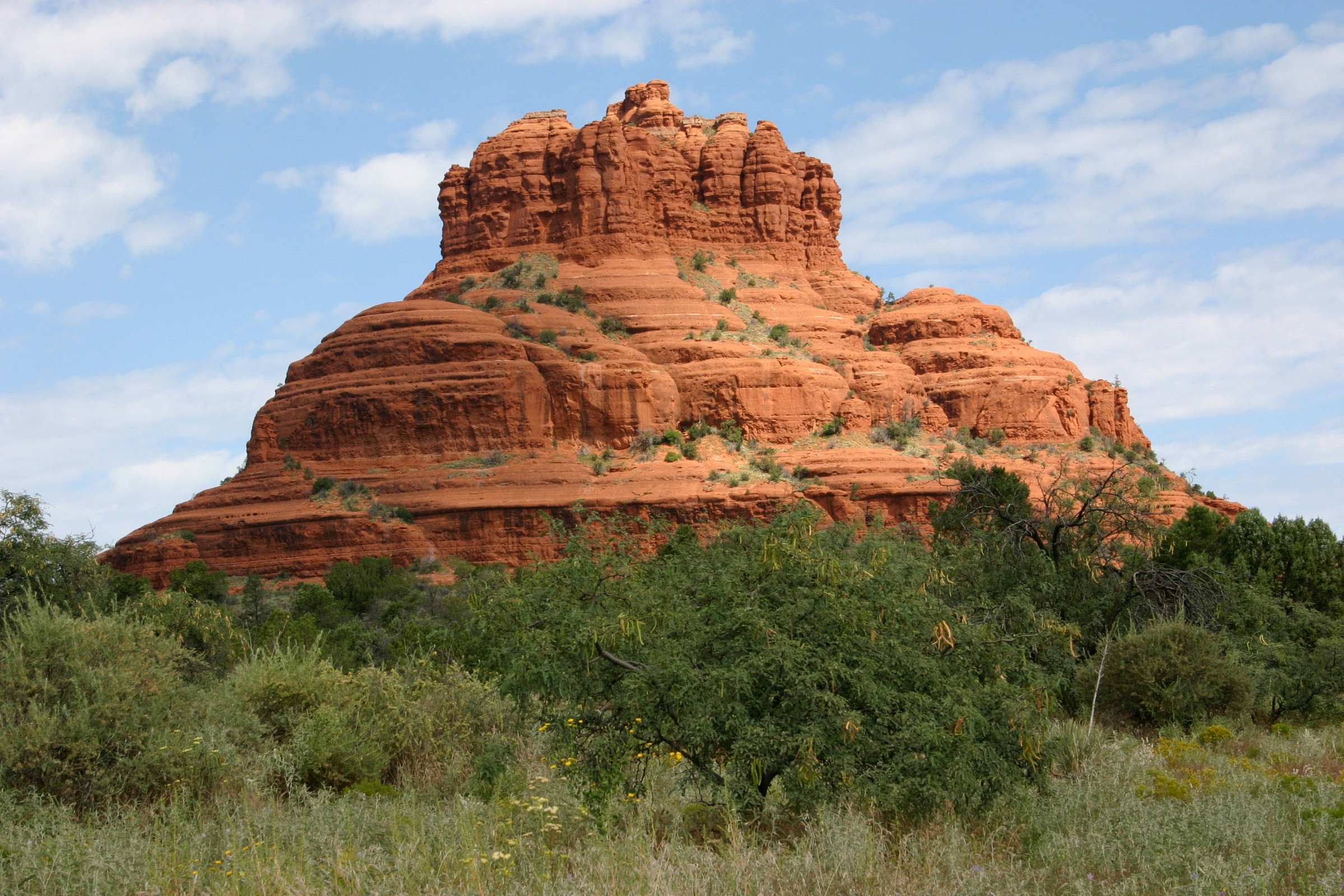
Bell Rock sits at the south end of Sedona near the Village of Oak Creek — worth pulling off at the trailhead just to walk the base and look up at the layers.
Why They Look Different at Different Times of Day
This part is geology meeting optics. Iron oxide absorbs blue and green light and reflects red and orange. At midday, when light is neutral white, the rocks look orange-red. At golden hour — especially that last 30 minutes before sunset — the warm light amplifies the red tones and the shadows go purple. It's not a filter. It's physics doing exactly what the iron wants it to do.
Cloudy days, honestly, are underrated. The diffused light brings out texture and makes the layers readable in a way that bright sun doesn't.
What This Means for How You See It
Once you know even a little of this, the landscape shifts. That red cliff isn't just a backdrop — it's a 270-million-year-old sand dune. That cream-colored band near the top of Cathedral Rock is a different desert entirely, from a different era. The creek running through town is actively reshaping what you're looking at.
If you make it out here, take one morning to drive up Schnebly Hill Road — it's unpaved and rough in spots, but it gets you up on top of the plateau where you can look back down at the formations from above and actually see how the layers sit. That view changes how you think about everything you see at eye level for the rest of your visit.
Notes from Sedona
Want these in your inbox?
Once a month I send the new posts straight to subscribers. Skip checking the site.